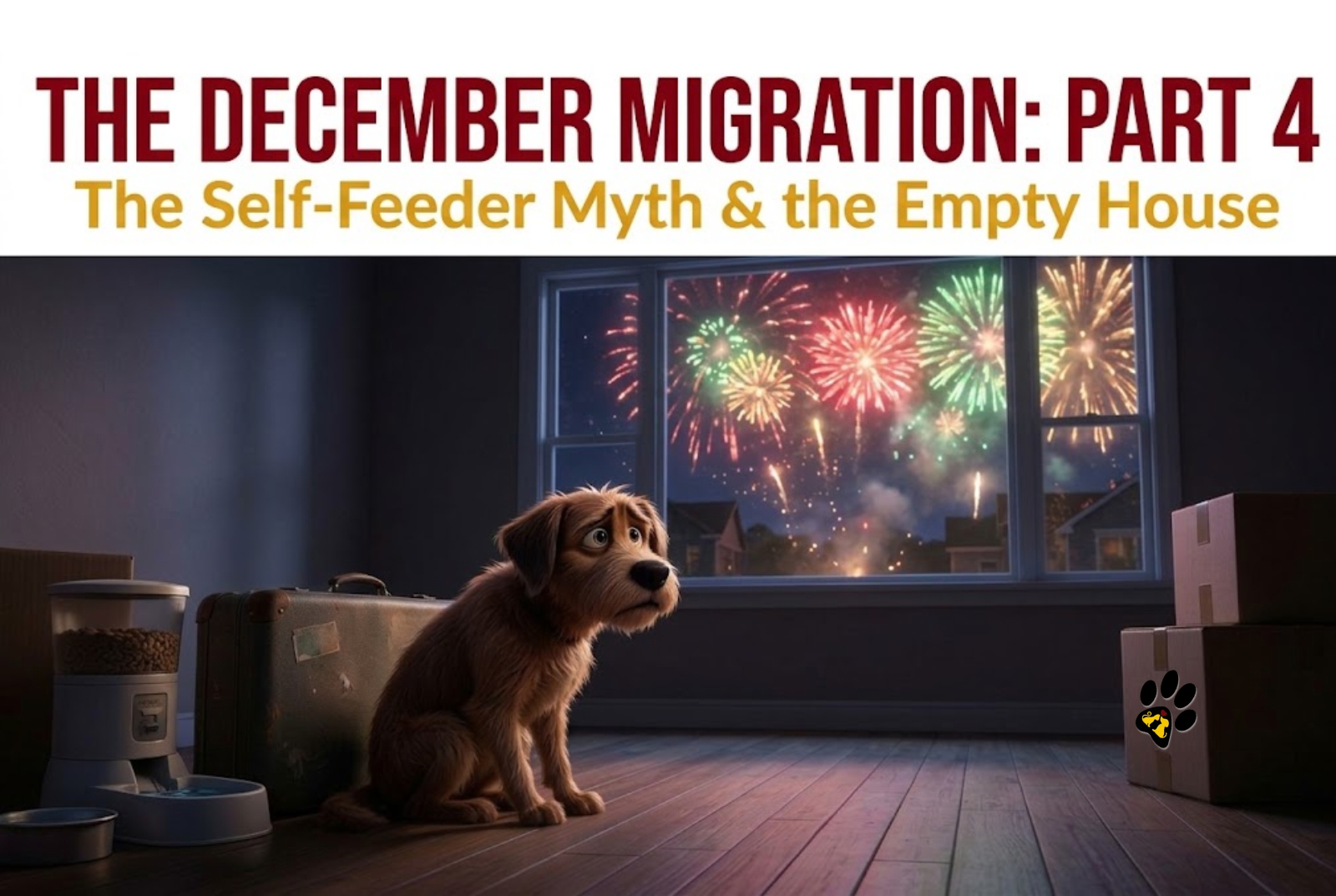
The December Migration, Part 4: The Self-Feeder Myth and the Reality of the Empty House
Listen to this article:
In this series, we have spoken a lot about holidaymakers bringing their dogs to the coast. But there is another side to the December migration: local residents packing up to leave the Garden Route, leaving their own pets behind.
We have strongly advised throughout this series that leaving your dog in their familiar environment is the best and safest choice. But often, well-meaning pet parents take this advice and try to cut corners on the care. They think they are doing the right thing, but they end up leaving their dogs home alone.
They buy a self-feeder, set out a few extra bowls of water, and ask a sitter to just "pop in" quickly once a day to check on things. They assume that as long as there is kibble in the bowl, the dog is happy.
This is a dangerous illusion.
The "Every Third Day" Reality Check
When I first started Happy Puppy, I received a call that I will never, ever forget. A local client was going away for December and asked for a quote for me to come in and feed her dogs once a day. When I gave her the professional rate, she paused and asked:
"Okay, how much will you charge me to come feed my dogs every third day?"
I was dumbfounded. What happens if the dogs playfully knock over their water bowl five minutes after I leave? Are they supposed to sit in the sweltering December heat without a drop of water for three days?
Beyond basic survival, dogs cannot clean up their own mess. If a dog gets an upset stomach or has an accident out of sheer anxiety, they are forced to live, sit, and sleep in their own waste until someone finally arrives to clean it up. Leaving an animal in that condition is not just irresponsible—it is disgusting.
Canine behavioral science shows us that dogs possess the cognitive ability and emotional intelligence of a two-year-old child. Would you leave a toddler alone in a house with an automatic feeder and only have someone check on them every 72 hours? It is unthinkable, yet people routinely expect it for their dogs.
The Sunset Panic and the December Chaos
I have been doing this full-time since 2017, and there is a very specific psychological shift I see in animals when the sun goes down.
During the bright hours of the day, a dog might seem relatively okay. But as it starts getting dark, they get restless. They watch the door. They realize mom and dad are not coming home from work. The house gets darker, the silence gets louder, and they get more and more frightened.
Now, multiply that fear by the reality of a coastal December. The vibe changes completely. The streets are packed, holidaymakers are loud, music is blaring from neighboring rentals, and the entire environment becomes an overwhelming sensory overload. For a dog that is scared of loud sounds, being trapped alone in a dark house while the neighborhood erupts in holiday chaos is sheer terror. Who is there to comfort them?
And then there is the ultimate nightmare: New Year's Eve. With the fireworks, the loud bangs, and the massive celebrations, an isolated dog will be in an absolute state of panic. How can anyone justify leaving a dog alone in an empty house on New Year's Eve?
When a professional sitter is there, we step in to bridge that gap. I can close the curtains, turn on some soothing background noise, sit with them, and tell them, "Listen, mom and dad aren't here, but I'm here. Everything is okay."
Imagine a dog left completely alone at night, growing increasingly terrified, with absolutely nobody there to comfort them. How can you do that to an animal that loves you?
The Sleep-In Solution and the Kahu Standard
I do offer check-in visits, and I will accept them initially to see how a specific animal copes with the routine. Some highly independent pets tolerate it. But if I see that your dog is not coping—if they are anxious, destructive, or pacing—I will immediately let you know that this arrangement is failing them. I am not going to blindly collect a paycheck while your animal suffers.
For dogs that are already used to being home alone for an 8-hour workday, the best and most ethical alternative is a sleep-in pet sitter. They maintain their normal daytime independence, but when the sun goes down, they have the ultimate security and comfort of someone physically being there, giving them attention, and ensuring they aren't left alone in the dark.
True Guardianship
True guardianship—the Kahu way—means putting your animal's emotional and physical safety above your convenience or your budget. If you are migrating this December, make sure you leave them in the hands of someone who will actually be there when the lights go out.